
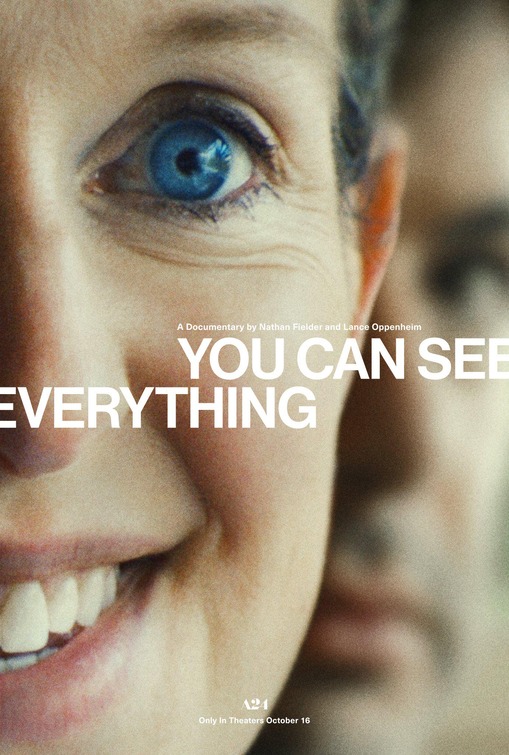
YOU CAN SEE EVERYTHING is the new A24 documentary from Nathan Fielder and Lance Oppenheim, the latter also being the director behind another A24 movie just released, PRIMETIME. This new film centers around the controversial figure of Elizabeth Holmes, who was the woman behind the company Theranos, and a patented device that was sold as a medical marvel, only to turn out being a major fraud case. Holmes profited billions, but ended up being sentenced to prison for her deception. This doc finds Fielder doing intimate interviews with Holmes and her partner Billy Evans (the father of her two children), beginning 30 days before she is put behind bars. We get to see up close and personal chats between Fielder and Holmes (and Billy) as they prepare for the inevitable, and get a bit of insight to how Holmes perceived the various events that led to this moment. In the process, questions are answers, but more questions are raised, and Fielder begins to wonder if these two are being honest with him, pr perhaps manipulating him to save face. At one point he even moves in to live with them for several days, ostensibly so that he can see and hear every tiny detail, with the thought being he may better understand another side to this story.
The Theranos story has already been the subject of various news specials and expose’ productions, and even a series called THE DROPOUT in which actress Amanda Seyfried portrayed Holmes. But in almost every interview and piece of footage we’ve seen before, it’s never been easy to understand exactly where Holmes is coming from, or what her true feelings and motivations really were. As Fielder attempts to discern what exactly happened, even he seems frustrated or puzzled by her, and things are further complicated by her devotion to her partner Billy, who is clearly a bit controlling and manipulative in his own way. But it’s also an interesting study in how everyone involved has their own goals, even Fielder as a documentarian trying to control the situation is in essence manipulating the viewers, and there are other unexpected elements introduced in the production that further the idea of depicting things from a forced perspective. It is a fascinating and uncomfortable character study of real people, all at least somewhat neurodivergent and interesting in their behavioral patterns.
Holmes repeatedly assures Fielder she has nothing to hide, and is being 100% transparent with him, but simultaneously displays odd emotional responses and rhetoric that keeps him (and the audience) guessing as to what’s really going through her head. Then there’s Billy, who clearly has his own agenda and quirks, which become increasingly disturbing as the film goes on, and almost make him look like more of a villain than Holmes could ever have been. Fielder’s techniques in finding the truth are complex and calculated in such a way that makes the three hour run time never once seem tedious. For example, there’s a brilliant scene in which he shows Holmes the classic Abbott and Costello “Who’s on first?” routine, noting some of their interactions remind him of it, and while she laughs at the cadence and dialogue, it’s clear she isn’t getting the joke. As he explains it to her and has to dissect why it’s funny, she smiles and nods while clearly not getting it – and as she’s smiling, she begins to cry, like a child desperately wanting approval from a parent they deeply care about. This is clearly a woman who is wired very differently, and it makes it hard to truly understand why she says and does the things she does… and that’s incredibly engaging to watch.
There’s a point in the film where the documentary does something very daring and unusual that will shock most viewers, but it works quite effectively. I can’t go into details without spoiling a large portion of the film, but it’s a master stroke that is equal parts brilliant and oddly amusing. Fielder obviously realized to tell this story in full, he had to get more creative, and the way he executes the second half of the movie is mind-blowing – it takes this from being an interesting documentary into one that is memorable and wildly entertaining. At times the dark tone and editing make this feel like a psychological horror film, but in the best possible way. It sticks with you, and it’s the kind of movie that begs discussion with others. I doubt any documentary this year will come close to the impact this one has, and it’s absolutely a must-see film for 2026. You are not ready for what’s in store here, but you definitely will be ready to talk about it when it’s over.


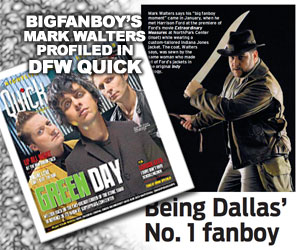
 Born and raised in Dallas, Mark has been a movie critic since 1994, with reviews featured in print, radio and National TV. In 2001 he started the Entertainment section of the Herorealm website, where he contributed film reviews and celebrity interviews until 2004. After three years of service there, he started Bigfanboy.com, which has become one of the Dallas film community's leading information websites. Bigfanboy hosts several movie screenings in the Texas area, and works closely with film and TV studios and promotional partners to host exciting events and contests. The site also features a variety of rare celebrity and filmmaker interviews, and Bigfanboy.com regularly covers the film festival circuit as well. In addition to Hollywood reporting, Mark has worked for many years as an advertising and sci-fi/comic book artist. Clients have included Lucasfilm Ltd., Topps Trading Cards, The Dallas Mavericks and The Dallas Stars. From 2002 until 2015 he managed the Dallas Comic Con, Sci-Fi Expo and Fan Days events in the DFW area. He currently catalogs rare comic books and movie memorabilia for Heritage Auctions, and runs the Dallas Comic Show conventions, but remains an avid moviegoer and cinema buff.